Yoga Postures >> Shanmukhi Mudra (Gesture of Closing the Six Gates) Yoga Posture
Why is it called Shanmukhi Mudra?
The name Shanmukhi Mudra is derived from two Sanskrit words:
Shan means six.
Mukhi means openings, gates, or faces.
This yogic gesture is called the Gesture of Closing the Six Gates because it involves gently closing the six primary sensory openings of the face, helping to withdraw the senses from external distractions and direct awareness inward. It is commonly practised with Bhramari Pranayama (Humming Bee Breath) to promote relaxation, concentration, and inner awareness.
How to Perform Shanmukhi Mudra
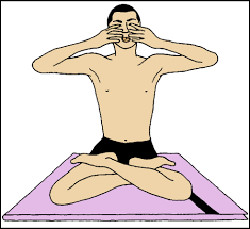
Sit comfortably on a yoga mat, the floor, or a chair with your spine straight.
Assume a comfortable meditation posture such as Padmasana (Lotus Pose), Sukhasana (Easy Pose), or any other stable seated position.
Raise both hands toward your face. Gently place your thumbs over the cartilage of the external ears to close the ear openings.
Rest your index fingers lightly above your eyebrows.
Place your middle fingers gently over the closed eyelids without applying pressure.
Position your ring fingers along the sides of the nostrils to partially regulate the airflow.
Rest your little fingers gently at the corners of your lips.
Take a slow, deep inhalation through the partially open nostrils.
Exhale slowly while focusing your attention on the Ajna Chakra (Third Eye Chakra). If practising with Bhramari Pranayama, produce a gentle humming sound during exhalation.
Repeat the practice for 5-10 rounds or as guided by a qualified yoga instructor.
After completing the practice, relax your hands, breathe normally, and observe the feeling of calmness and inner awareness.
Benefits of Shanmukhi Mudra
Enhances mental clarity, concentration, and mindfulness.
Improves awareness and perception of the five senses, like hearing, vision, smell, taste, and touch.
Helps calm the mind by reducing external sensory distractions.
Supports stress relief, relaxation, and emotional balance.
May improve breathing efficiency and lung capacity, especially when practised with Bhramari Pranayama.
Promotes inward focus and prepares the mind for meditation.
Final Pose Picture
Best Books on Yoga
Yoga The Path to Holistic Health: The Definitive Step-by-Step Guide by B.K.S. Iyengar
The Complete Book of Vinyasa Yoga: The Authoritative Presentation-Based on 30 Years of Direct Study Under the Legendary Yoga Teacher Krishnamacha by Srivatsa Ramaswami