|
|
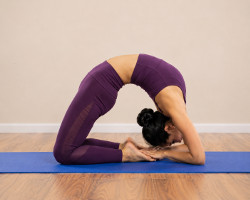
How to Do Kapotasana (Pigeon Pose)
Kapotasana (Pigeon Pose) is an advanced backbend yoga posture that helps improve spinal flexibility, strengthen the core, open the chest, and enhance overall body balance. This pose requires proper flexibility, strength, and controlled breathing.
Steps to Perform Kapotasana
- Lie comfortably on your back with your spine relaxed and your legs hip-width apart.
- Inhale deeply and slowly raise both arms overhead, extending them behind your head.
- Gradually bend both knees and bring your feet close to your buttocks, placing the soles firmly on the floor.
- Press your feet and palms into the floor and slowly lift your torso upward, arching your back.
- Continue lifting and bending your body to form a smooth arch while maintaining balance through your hands and feet.
- Gently lower your hands toward the floor behind you, creating a deep backbend.
- Fix your gaze on a stable point behind you to improve balance and maintain your posture.
- In the final position, try to hold your feet, ankles, or toes with your hands, depending on your flexibility. Your elbows may remain slightly bent or rest comfortably on the floor.
- Keep your chest open, neck relaxed, and spine fully extended in a graceful arch.
- Breathe normally and hold the pose for 5-6 deep breaths.
- Exhale slowly and carefully return to the starting position without any sudden movements.
- Relax your spine, neck, shoulders, and waist.
- Place your arms alongside your body and rest.
- Repeat the posture 2-3 times as per your comfort level.
|
Benefits of Kapotasana
Strengthens the core and abdominal muscles.
Helps reduce neck and shoulder stiffness.
Improves spinal flexibility and posture.
Strengthens the back muscles and may help prevent back pain.
Enhances balance, coordination, and body awareness.
Improves flexibility of the thighs, hips, and waist.
|
Indications
Kapotasana may be beneficial for:
Mild back stiffness and reduced spinal flexibility.
Weakness in the legs and balance-related issues.
Supporting fitness goals related to abdominal and waist toning.
Strengthening the arms, shoulders, and core muscles.
|
Contraindications
Avoid or practice under expert supervision if you have:
Spinal injuries or severe back pain.
Shoulder, wrist, or arm injuries.
High blood pressure, dizziness, or balance disorders.
Arthritis or severe joint disorders.
Any medical condition that restricts deep backbends.
|
Who Can Practice Kapotasana?
Healthy individuals with adequate flexibility and strength.
Teenagers and adults till 50 years who have experience with intermediate or advanced yoga postures.
Practitioners under the guidance of a qualified yoga instructor.
Who Should Avoid Kapotasana?
Pregnant women.
Individuals recovering from spinal, shoulder, or wrist injuries.
Senior citizens aged 60-70 with limited mobility or balance issues.
Beginners who have not developed sufficient flexibility for advanced backbends.
|
|
Final Pose Picture
|
|
 |
Yoga The Path to Holistic Health: The Definitive Step-by-Step Guide by B.K.S. Iyengar |
Buy Online Now |
 |
Yoga for Everyone: A Step-by-Step Illustrated Guide to Iyengar Yoga by B.K.S. Iyengar |
Buy Online Now |
 |
Light on Yoga: The Classic Guide to Yoga by the World's Foremost Authority by B.K.S. Iyengar |
Buy Online Now |
 |
The Complete Book of Vinyasa Yoga: The Authoritative Presentation-Based on 30 Years of Direct Study Under the Legendary Yoga Teacher Krishnamacha by Srivatsa Ramaswami |
Buy Online Now |
 |
The Seven Spiritual Laws of Yoga: A Practical Guide to Healing Body, Mind, and Spirit by Deepak Chopra M.D. and David Simon M.D. |
Buy Online Now |
 |
Mudras of India: A Comprehensive Guide to the Hand Gestures of Yoga and Indian Dance |
Buy Online Now |
 |
One Simple Thing: A New Look at the Science of Yoga and How It Can Transform Your Life |
Buy Online Now |
 |
From the Vedas to Vinyasa: An Introduction to the History and Philosophy of Yoga |
Buy Online Now |
|
Manuscripts are invited for next Issue at ijapc.com
Features
Herbs and Medicinal Plants
|