|
|
How to Do Hanumanasana (Monkey Pose)
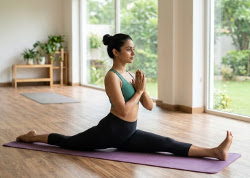
Hanumanasana, also known as Monkey Pose, is an advanced yoga posture that involves a deep stretch of the legs, hips, and thighs. It requires flexibility, balance, and proper body alignment. Beginners should practise Hanumanasana gradually and under the guidance of a qualified yoga instructor.
Steps to Perform Hanumanasana
- Stand upright with your feet together and take a few deep, comfortable breaths.
- Slowly inhale and step your right leg forward while extending your left leg backwards.
- Gradually increase the distance between your legs as you lower your body toward the floor.
- Bring both knees toward the floor and continue extending the legs in opposite directions.
- Slowly lower your buttocks toward the floor while keeping both legs extended in opposite directions.
- In the final position, keep your spine straight and face forward. Place both hands together in Namaskar Mudra or keep your hands on the floor for support, as comfortable.
- Breathe slowly and deeply while maintaining the posture without forcing the stretch.
- To release the pose, slowly bend your front knee and bring the extended leg back to a comfortable position.
- Return to Dandasana (Staff Pose) and relax.
- Repeat the posture on the opposite side.
|
Benefits of Hanumanasana (Monkey Pose)
Helps improve flexibility in the legs and hips.
Supports better balance and body awareness.
Improves overall lower-body flexibility when practised regularly.
Helps reduce stiffness in the thighs, hips, and lower body.
Provides a deep stretch to the thighs and leg muscles.
Can be beneficial for athletes and sportspersons who require good lower-body flexibility and stretching.
|
Indications
Hanumanasana may be included in a yoga routine for:
Supporting lower-body stretching for athletes and sportspersons.
Practising controlled stretching of the thighs, hips, and legs.
Useful as part of a healthy lifestyle for people with excess body weight.
|
Contraindications and Precautions
Avoid or practise Hanumanasana only with professional guidance if you have:
A recent or severe back or spinal injury.
Hamstring, tendon, hip, knee, or other leg injuries.
A fracture or significant musculoskeletal problem.
Severe pain or restricted mobility in the hips or legs.
Pregnancy, unless the posture has been specifically recommended and modified by a qualified prenatal yoga professional.
During menstruation, practise according to your comfort level and avoid the pose if it causes pain or discomfort.
|
Who Can Practice Hanumanasana?
Hanumanasana is an advanced posture and is not determined by age alone. Suitable for people aged 14 to 50 years.
People with adequate flexibility and physical ability can gradually learn the pose under proper guidance.
|
Who Should Avoid Hanumanasana?
People with significant injuries, severe joint or muscle problems, limited mobility, or other medical concerns should avoid practicing this mudra.
Older adults should not attempt the full posture without appropriate supervision and preparation.
Not recommended for pregnant women and seniors over 60 without professional guidance.
|
|
Final Pose Picture
|
|
 |
Yoga The Path to Holistic Health: The Definitive Step-by-Step Guide by B.K.S. Iyengar |
Buy Online Now |
 |
Yoga for Everyone: A Step-by-Step Illustrated Guide to Iyengar Yoga by B.K.S. Iyengar |
Buy Online Now |
 |
Light on Yoga: The Classic Guide to Yoga by the World's Foremost Authority by B.K.S. Iyengar |
Buy Online Now |
 |
The Complete Book of Vinyasa Yoga: The Authoritative Presentation-Based on 30 Years of Direct Study Under the Legendary Yoga Teacher Krishnamacha by Srivatsa Ramaswami |
Buy Online Now |
 |
The Seven Spiritual Laws of Yoga: A Practical Guide to Healing Body, Mind, and Spirit by Deepak Chopra M.D. and David Simon M.D. |
Buy Online Now |
 |
Mudras of India: A Comprehensive Guide to the Hand Gestures of Yoga and Indian Dance |
Buy Online Now |
 |
One Simple Thing: A New Look at the Science of Yoga and How It Can Transform Your Life |
Buy Online Now |
 |
From the Vedas to Vinyasa: An Introduction to the History and Philosophy of Yoga |
Buy Online Now |
|
Manuscripts are invited for next Issue at ijapc.com
Features
Herbs and Medicinal Plants
|